

 (833) 569 7223


The only difference between hemp-derived THC and marijuana-derived THC is legality. Both contain the exact same Delta-9 THC molecule and cause the same effects, but hemp-derived THC is federally legal if under 0.3% on a dry weight basis, while marijuana-derived THC is federally illegal but permitted in some states.
The CBD industry continues to grow, and hemp remains a staple in the wellness space. Legal hemp-derived products are widely available, with CBD firmly established as a popular option for natural support. More recently, THC-derived compounds from hemp have also gained attention, marking a new chapter in the evolution of hemp-based offerings.
Yes, we’re talking about the same intoxicating THC that’s been illegal at the federal level for almost 100 years. Guess what? When it’s derived from hemp and products contain less than 0.3% THC, THC is considered compliant with the Farm Bill. Even when it may cause an intoxicating effect.
There’s a difference between hemp-derived THC and marijuana-derived THC, most of which comes down to legality. Here we’ll take a closer look at all things legal THC, particularly when the cannabinoid is derived from hemp.
Is Hemp-Derived THC Legal?
Let’s talk about THC legality.
When the Farm Bill was passed, it legalized hemp on the federal level. It was removed from the Controlled Substances Act (CSA) and categorized as an agricultural commodity. Essentially, this removed any THC present in hemp from the CSA as well.
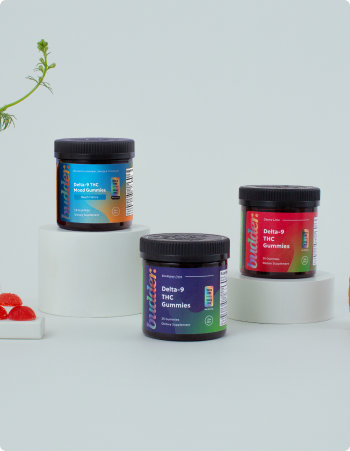
Our CBD + THC Gummies contain THC and are totally legal at the federal level. Wondering how this is possible? It comes down to two specific things: the THC in our gummies is derived from hemp, and the gummies contain less than 0.3% THC on a dry weight basis.
By law, hemp is defined as “the plant Cannabis sativa L. and any part of that plant, including the seeds thereof and all derivatives, extracts, cannabinoids, isomers, acids, salts, and salts of isomers, whether growing or not, with a delta-9 tetrahydrocannabinol concentration of not more than 0.3 percent on a dry weight basis.” Ultimately this definition protects both hemp-derived CBD and hemp-derived THC.
Our CBD + THC gummies are derived from hemp and contain less than 0.3% THC on a dry weight basis. What exactly does “dry weight basis” mean? According to USDA legislation, dry weight basis is defined as: “A basis for expressing the percentage of a chemical in a substance after removing the moisture from the substance. Percentage of THC on a dry weight basis means the percentage of THC, by weight, in a cannabis item (plant, extract, or other derivative), after excluding moisture from the item.”
Because our CBD + THC gummies follow both of the above hemp legislation definitions, they’re legal at a federal level, are protected in interstate commerce, and can be legally shipped to all 50 states.
What Is the Difference Between Hemp-Derived and Marijuana-Derived THC?
There’s a difference between hemp-derived THC and marijuana-derived THC, most of which comes down to legality. Hemp-derived THC is legal at the federal level when it contains less than 0.3% THC on a dry weight basis, while marijuana-derived THC remains federally illegal and is only legal in states that have passed medical or recreational marijuana laws.
Federal vs. State THC Law Breakdown
-
Hemp-derived THC (under 0.3% Delta 9 THC by dry weight)
Federally legal under the 2018 Farm Bill -
Marijuana-derived THC
Federally illegal, but legal in states with medical or recreational cannabis laws -
Important clarification
Both forms contain the same THC molecule. The difference is legal classification, not chemistry or effects.
How Is Delta-8 THC Different From Delta-9 THC?
You might’ve noticed the big increase in legal Delta-9 and Delta-8 THC products, both of which are legal at the federal level when derived from hemp and containing no more than 0.3% THC on a dry weight basis. They contain the same molecular structure, aside from the location of a double bond between two carbon atoms.
Delta-9 THC is the type of THC that most people are familiar with, and what we’ve chosen to use in our CBD gummies. It’s the most abundant cannabinoid found in cannabis (CBD is second), and it’s the cannabinoid that’s been studied the most extensively. It’s also what produces the mind-altering effects THC is famous for.
Delta-8 causes similar mind-altering effects to Delta-9, but only a very small amount is found in cannabis. The levels of Delta-8 produced in cannabis are so low it’s considered a minor cannabinoid that has received very limited attention until very recently. It’s also so difficult to extract from cannabis that the large majority of what’s available on the market is heavily processed.
So why are we seeing more Delta-8 THC products? It’s simple. The CBD industry is overly saturated and CBD producers interested in increasing their revenue have discovered that by converting CBD into Delta-8 THC, they can significantly increase their profit margins. It’s legal, after all, and can be sold in states without recreational cannabis laws.
The process to convert CBD into Delta-8 THC involves an aggressive reaction process that uses a variety of chemicals and acids. The result of this process offers a product that contains reaction byproducts, isomers, and cannabinoids not naturally found in cannabis—many of which have not been tested for safety.
Not exactly what most people are looking for when choosing a product intended to support their well-being. Keep in mind that the legal CBD market is still highly unregulated. Without FDA approval, products like Delta-8 can be marketed and sold despite any impurities they might contain.
Delta-9 THC is different. As the most abundant cannabinoid, it can be easily and inexpensively extracted. We believe cannabis products should be as pure as possible, which is exactly why we’ve chosen quality hemp-derived Delta-9 THC for our CBD/THC gummies.
Does Hemp-Derived THC Get You High?
What about the effects of hemp-derived THC, though? Are they different from THC that’s been derived from marijuana?
Not in the slightest. Check it out.
Hemp THC and marijuana THC produce the same euphoric and psychoactive effects. There is no difference in how the body processes them.
Are the Effects of Hemp THC Different From Marijuana THC?
Most people that use products containing THC do so for the mind-altering effects the cannabinoid produces. Because CBD is non-intoxicating and derived from hemp, it’s often assumed that the effects of hemp-derived THC might be different from that derived from marijuana.
Here’s the thing, though. It’s the exact same molecule. The effects a cannabinoid produces aren’t different just because it’s extracted from a different plant. Delta-9 THC is still Delta-9 THC, whether it comes from hemp or marijuana, offering the same blissfully relaxing, euphoric effects that have made it famous.
Is Hemp THC Safer Than Marijuana THC?
When it comes down to it, Delta-9 THC is the same compound no matter where it comes from. The biggest difference between hemp-derived THC and marijuana-derived THC is the legality at the federal level.
Hemp-derived THC is legal as long as it contains less than 0.3% on a dry weight basis, while marijuana-derived THC is only legal in states that have passed medical or recreational marijuana laws. Marijuana-derived THC is still considered illegal at the federal level.
Legal hemp THC is game-changing for the cannabis industry, offering consumers across the country an opportunity to legally experience THC’s effects and potential benefits.
FAQs
Are hemp Delta-9 THC products synthetic?
No. Hemp Delta-9 THC products are not synthetic as long as the THC comes directly from the hemp plant and stays within the legal 0.3% Delta-9 THC limit. Synthetic cannabinoids are made in a lab and are not the same as naturally occurring hemp-derived Delta-9 THC.
Can synthetic Delta-9 THC cause health risks?
Yes. Synthetic cannabinoids can pose health risks because they are created with chemical processes that may produce unpredictable or harmful effects. Naturally derived hemp Delta-9 THC is generally considered safer when sourced from reputable brands.
How can I check if my THC gummies are lab-tested?
The best way is to look for a third-party Certificate of Analysis (COA). Trusted companies make these lab reports available on their websites or through QR codes on the packaging, showing cannabinoid content and confirming the absence of contaminants.
Does synthetic Delta-9 THC work the same as natural?
Not exactly. While synthetic versions may try to mimic the effects of natural Delta-9 THC, they don’t interact with the body in the same way and can produce different, sometimes negative, effects. Natural hemp-derived Delta-9 THC is the form most people are familiar with.
































Join in on the Conversation
Your email address will not be published. Once your comment is approved, it will be published.