(833) 569 7223


Full Spectrum CBD Oil: What It Is, How It Works & Why It Matters
By Todd Smith, Co-Founder of Joy Organics
Scientifically reviewed by Dr. Jill Palko, OB-GYN — Last reviewed: June 2026

"Full spectrum" is one of the most meaningful distinctions in the CBD oil market — and one of the most misunderstood. This page explains exactly what full spectrum CBD oil is, how it differs from broad spectrum and isolate, and why the entourage effect matters for everyone making a purchasing decision.
What Is Full Spectrum CBD Oil?
Full spectrum CBD oil contains the complete range of compounds naturally occurring in hemp-derived CBD products from the Cannabis sativa plant:
- CBD — the primary cannabinoid, present in the largest amount, also known as cannabidiol CBD
- Minor cannabinoids — CBG (cannabigerol), CBN (cannabinol), CBC (cannabichromene), and others in smaller amounts
- Terpenes — aromatic compounds like myrcene, linalool, beta-caryophyllene, and limonene that contribute to the oil's character and have their own documented pharmacological properties
- Flavonoids — hemp plant compounds with antioxidant properties
- Trace THC — less than 0.3% by dry weight, as required by federal law under the legal definition for hemp-derived products compliant with the Controlled Substances Act. Non-intoxicating at this level.
The "full spectrum" designation means minimal post-extraction processing — the extract is diluted in a carrier oil without removing any compounds beyond what's naturally present, ensuring purity and maintaining the full range of compounds characteristic of full spectrum CBD products.
How Full Spectrum Differs from Broad Spectrum and Isolate CBD Products
| Type | CBD | Minor Cannabinoids | Terpenes | THC |
|---|---|---|---|---|
|
Full Spectrum |
Yes |
Yes |
Yes |
Yes (<0.3%) |
|
Broad Spectrum |
Yes |
Yes |
Yes |
No (removed) |
|
Isolate |
Yes |
No |
No |
No |
Broad spectrum CBD undergoes an additional processing step to remove THC content while retaining other cannabinoids and terpenes. The entourage effect is partially maintained — you still get the benefit of multiple cannabinoids and terpenes, just without any THC.
Isolate is pure CBD only. It's been refined to remove all other hemp compounds. No entourage effect.
The Entourage Effect: Why Full Spectrum May Work Better
The entourage effect refers to the synergistic interaction between cannabinoids, terpenes, and flavonoids found in full spectrum hemp extract. The theory — and growing body of supporting research — is that these compounds work more effectively together than any single compound alone.
Dr. Ethan Russo's landmark 2011 review documented the pharmacological interactions between cannabinoids and terpenes, finding that terpenes like linalool (calming, sleep-relevant), myrcene (sedative properties, found in hops and the cannabis plant), and beta-caryophyllene (CB2 receptor agonist, anti-inflammatory relevant) contribute meaningfully to the full profile of hemp's effects. [1]
A 2019 study from Israeli researchers found that full spectrum CBD extract outperformed CBD isolate for anti-inflammatory effects across all dose ranges, with full spectrum showing a more consistent dose-response curve. [2]
Practical implication: If two products have the same CBD content, a full spectrum product may produce better outcomes than an isolate product — not because it has more CBD, but because the full plant profile works synergistically.
Trace THC in Full Spectrum CBD Oil
The trace THC (under 0.3%) in full spectrum hemp oil is a feature, not a flaw. At this level:
- Non-intoxicating. You will not feel high from full spectrum hemp CBD oil. The trace amounts are pharmacologically active at the receptor level in ways that contribute to the entourage effect, but they do not produce psychoactive effects.
- Drug testing consideration. Regular use of full spectrum CBD products at higher doses could potentially accumulate detectable THC-COOH in urine tests. For drug-tested athletes, employees, or anyone who wants to avoid THC, broad spectrum CBD products (non-detectable THC) are the safer choice.
- Legal status. Hemp-derived full spectrum CBD oil containing less than 0.3% THC is federally legal under the 2018 Farm Bill.
Who Should Choose Full Spectrum CBD vs. Broad Spectrum CBD
Choose full spectrum CBD if:
- Maximum entourage effect is the priority
- You're comfortable with trace THC
- You are not subject to drug testing
- You want the most complete expression of hemp's natural compound profile
Choose broad spectrum CBD (THC-free) if:
- Drug testing is a concern (workplace, sports, professional)
- You have personal reasons to avoid all THC
- You're giving it to a pet (dogs are more THC-sensitive than humans)
Both full spectrum and broad spectrum are significantly preferable to CBD isolate for most wellness applications.
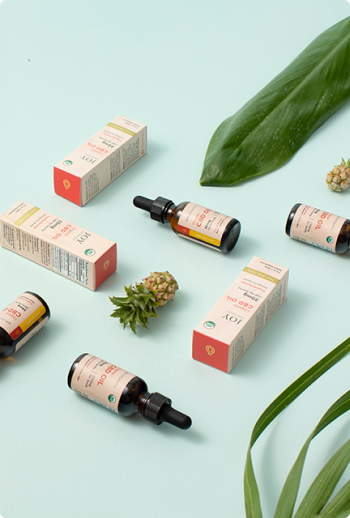
Joy Organics Full Spectrum CBD Oil
Joy Organics full spectrum CBD oil is:
- USDA certified organic (verifiable at ams.usda.gov/organic-integrity)
- Colorado-grown hemp
- CO2 extracted for purity and terpene preservation
- Available in multiple potencies
- Batch-specific COA published for every lot
- Free shipping on all orders
Frequently Asked Questions
What is full spectrum CBD oil?
Full spectrum CBD oil contains CBD plus minor cannabinoids (CBG, CBN, CBC), terpenes, flavonoids, and trace THC (under 0.3%) — the complete compound profile of hemp. It produces the entourage effect, where all compounds work synergistically, enhancing the benefits associated with the body's endocannabinoid system.
Will full spectrum CBD oil make me high?
No. Hemp-derived full spectrum CBD oil contains less than 0.3% THC — far too little to produce any psychoactive effect. It is non-intoxicating.
Is full spectrum CBD oil better than CBD isolate?
For most wellness applications, yes. Research supports better outcomes from full spectrum vs. isolate due to the entourage effect. The exception: isolate is appropriate when any trace of THC is unacceptable.
Does full spectrum CBD oil have THC in it?
Yes, in trace amounts (under 0.3%). This is legal under the 2018 Farm Bill and not enough to cause intoxication. The amount is confirmed on the third-party-testing COA. All CBD products, including full spectrum CBD capsules, oils, gummies, creams, etc., should avoid harmful pesticides and heavy metals for safety reasons.
Is full spectrum or broad spectrum CBD oil better?
Full spectrum has the complete entourage effect with trace THC. Broad spectrum is THC-free while retaining other cannabinoids. Full spectrum is preferred for maximum efficacy; broad spectrum is appropriate when THC must be avoided.
Full spectrum CBD may cause mild side effects like fatigue and diarrhea, and interact with prescription drugs like blood thinners. Always consult with a healthcare professional if you take certain medications or are pregnant or breastfeeding to ensure safety.
The Bottom Line
Full spectrum CBD oil represents hemp at its most complete — CBD alongside CBG, CBN, terpenes, flavonoids, and trace THC working synergistically through the entourage effect. The research supporting full spectrum over isolate is meaningful. For most general wellness applications where drug testing isn't a concern, full spectrum is the recommended choice.
Shop Joy Organics Full Spectrum CBD Oil →
These statements have not been evaluated by the Food and Drug Administration. These products are not intended to diagnose, treat, cure, or prevent any disease. Consult a healthcare provider before adding any supplement to your routine.
Sources
- Russo EB. "Taming THC: Potential Cannabis Synergy and Phytocannabinoid-terpenoid Entourage Effects." British Journal of Pharmacology. 2011;163(7):1344–1364.
- Gallily R, et al. "Overcoming the Bell-Shaped Dose-Response of Cannabidiol by Using Cannabis Extract Enriched in Cannabidiol." Pharmacology & Pharmacy. 2015;6(2):75–85.